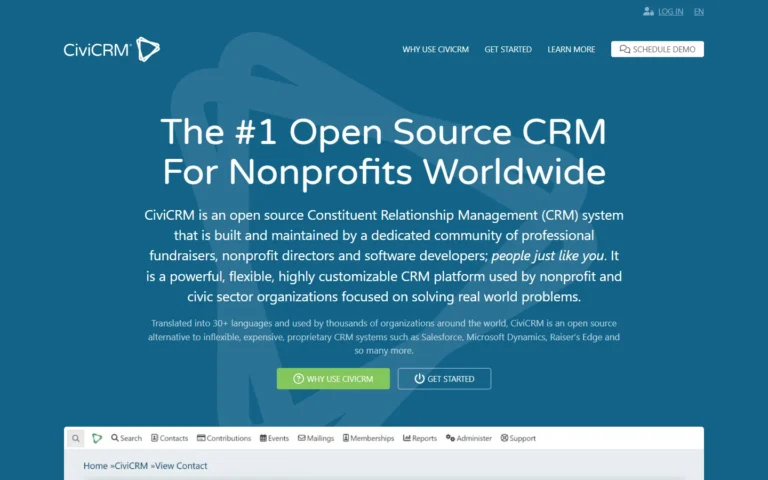
CiviCRM
Free (self-hosted)
Free, open-source CRM for managing contacts, donors, members, events, and communications. Free to download and use. Hosting, setup, maintenance, and support may cost money.
Free
Open source
Software
Discover the best CRM for your nonprofit and save money. You can filter by features, price, and type. To avoid mistakes, check also the comparison and FAQ below.
Free (self-hosted)
Free, open-source CRM for managing contacts, donors, members, events, and communications. Free to download and use. Hosting, setup, maintenance, and support may cost money.
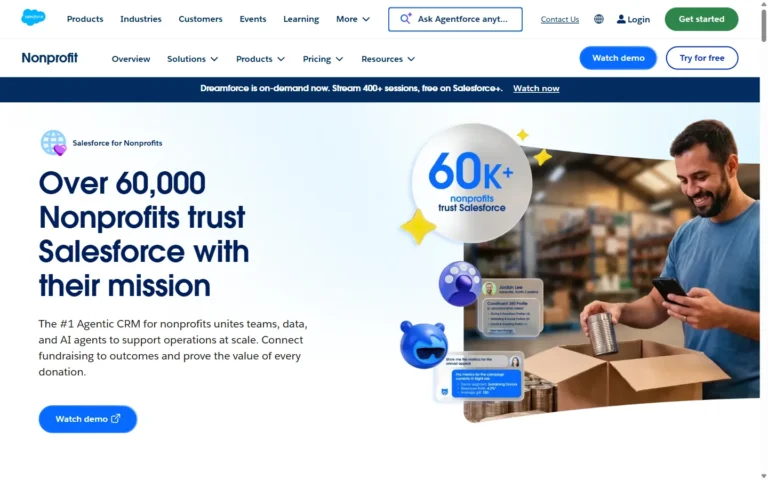
Free (10 licenses)
Leading nonprofit CRM with 10 free licenses. Salesforce Power of Us gives eligible nonprofits 10 free Nonprofit Cloud or Sales and Service Cloud licenses with discounts on extra...
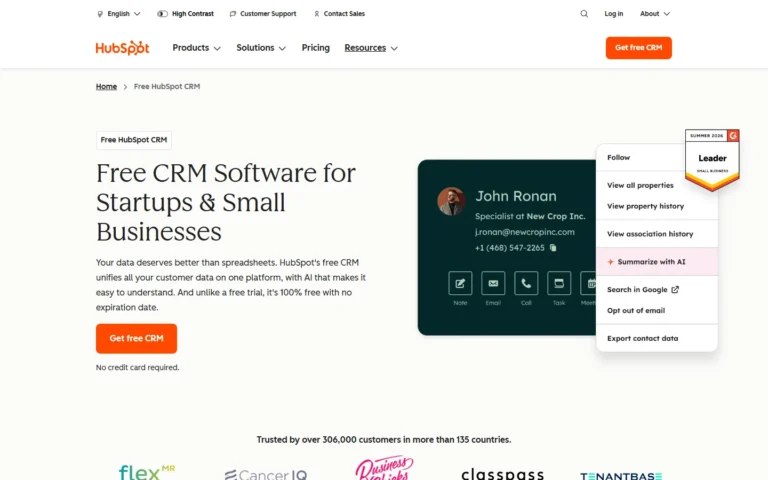
40% discount + free plan
All-in-one CRM with 40% off Pro and Enterprise for nonprofits. HubSpot gives registered nonprofits in North America, Australia, and New Zealand 40% off Pro and Enterprise Hubs on...
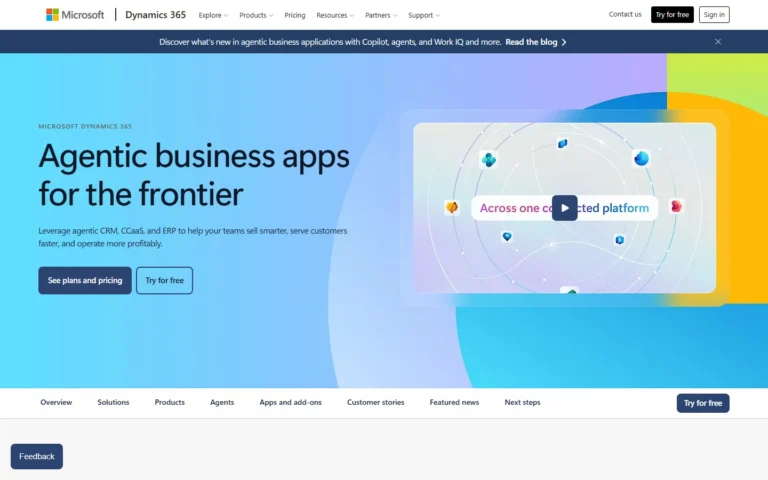
Custom discount
Donor and operations CRM with discounted nonprofit licenses. Microsoft Dynamics 365 gives recognized nonprofits discounted licenses: Power Apps free for 10 users plus $2.50 per extra user, Sales...
50% discount
55+ app suite with a $5,000 credit covering half of each bill. Zoho gives registered nonprofits a one-time $5,000 credit applied as a 50/50 split on every transaction...
| Tool | Price | Setup | Best for | Watch for |
|---|---|---|---|---|
| CiviCRM | FreeOpen source | High | Open-source control and nonprofit-specific relationship management. | Hosting and technical support can add cost. |
| Salesforce | Free limited | High | Complex fundraising, program and reporting workflows. | Implementation and administration can be substantial. |
| Hubspot | Free limitedDiscount | Low | Contact management combined with marketing and forms. | The discount has product and regional restrictions. |
| Microsoft Dynamics 365 | Discount | High | Microsoft-based operations and connected business processes. | It usually needs configuration expertise or a partner. |
| Zoho | Discount | Moderate | CRM plus other business applications in one suite. | The nonprofit benefit is a one-time credit. |
There is no single best CRM for every nonprofit. The right choice should support priority relationships without forcing the team to maintain duplicate systems.
A strong fit for one organization can be unnecessarily complex or too limited for another, so these criteria should define the initial shortlist.
The decision depends on the range of relationships and processes you need to manage.
General CRMs are usually more flexible, but they may require nonprofit-specific configuration and specialist support.
It can be a sensible starting point for a small team, a modest contact database and straightforward workflows, provided it covers essential records, permissions and exports.
Compare the cost of the complete workflow. A free plan is a poor fit when essential work depends on parallel spreadsheets or paid add-ons.
Prioritize features that solve a documented problem and classify each requirement as must-have, useful or later.
Avoid platforms that require awkward workarounds or paid add-ons for critical tasks.
The CRM should connect reliably to systems that create or use constituent data every day.
An integration badge is not enough. The connection should remove a real manual step without weakening data quality.
Start with decisions the organization must make, then ask each provider to produce those reports with realistic sample data.
A polished dashboard is less valuable than accurate, repeatable reports that support the organization’s regular decisions.
The review should cover technical security, data handling and the organization’s internal rules.
Involve the person responsible for privacy before shortlisting systems that will hold sensitive information.
Use the same weighted scorecard and practical scenario for every option.